
Today was one of those days, and it has carried over into the night. I’m exhausted, physically and mentally. My limbs feel like they’re filled with wet sand, my brain like it’s running on wine and stress. But before I let the day end, I’m here to say it: I’m still here.
Late last year, I started a balcony garden. I didn’t know a thing about planting or pruning or any of the million small acts it takes to keep something alive in the dirt. But I had this deep pull in my chest, like a string tugging me toward something I couldn’t name. That pull told me to make a little oasis for myself, a place where I could sit in the air and feel quiet again. So I did.
Twenty-seven plants later, I was feeling a little proud of myself. A little green kingdom. And then summer came, with its sharp heat and unrelenting sun, and I killed nearly half of them.
But we learned, the plants and I. We fought back in our slow way. We replanted. We fertilized. We deadheaded. We waited. We watched the sun rise over the ocean and sink behind the mountains, over and over, each cycle a tiny push reminding us to carry on.
That’s the thing about tending anything that grows in the dirt. You learn to wait. You learn to watch. You learn to recognize signs that tell you something is about to shift.
There was one plant I was especially taken with. When I brought her home, she was glorious, a firework of color in every cluster of blooms, shades of fuchsia, yellow, and orange so alive they looked like they’d been painted by Monet, but less muddled. I cared for her, watered, fed, shielded her in the hot afternoons with the awning I would draw every day to protect them. I was diligent. Until one day I wasn’t.
I forgot to drop the awning. Just one day. But it was a day when the sun was so bright it stung, and the heat was the kind that presses against your skin and won’t let go. By the time I saw her again that evening, the edges of her leaves were black and brittle, her petals curled in on themselves, hurt, trying to hide from what had happened. In that one day, I didn’t just lose her blooms. I lost my lavender, my mint, my Gerber daisies. It was the kind of gut punch you can only get when it’s you beating yourself up.
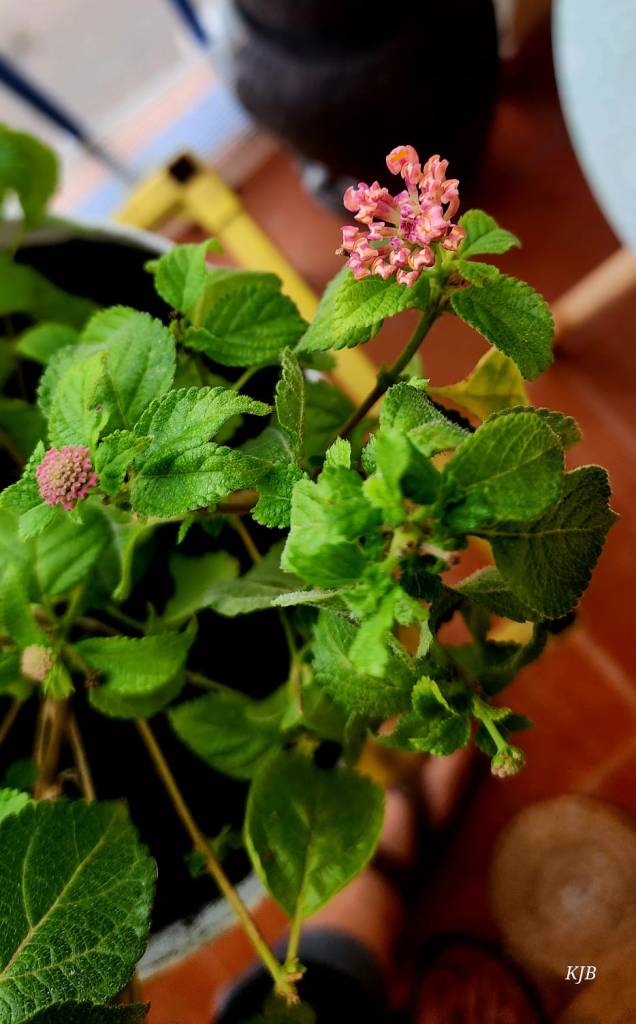
I was heartbroken, but I didn’t give up. I watered them. Fed them. Trimmed away what couldn’t be saved. And then I waited. They waited with me. Inch by stubborn inch, they began to grow again. And today, my little fighter, who took her sweet time (as we should after a trauma), finally began to bloom again.
It’s hard to miss the metaphor when you’re staring at something like that. Coming back from the ashes. The way life moves in cycles, endings and beginnings braided so tightly you can’t always tell one from the other. The kind of resilience that hides inside something delicate enough to fit in your palm.
Somewhere in the middle of all that, I realized why the pull to plant had been so strong in the first place. My mom. Some of my strongest memories were of her tending to her plants. The way she cared for them with a kind of fierce gentleness. The way she talked to them, confiding in them things she probably wouldn’t have said to another person. And the way they seemed to answer her, not in words, but in blooms. As if to say, we see you.
She survived things I can’t even bring myself to imagine. She knew what it was to be scorched by life and to keep going anyway. And maybe, without realizing it, that’s what I was trying to feel by building this garden, a little closer to her.
Today, I took these pictures of my fighter. The first blooms since that fateful awning day, or “AW MAN!” day, as I now call it. She doesn’t remember what happened. She doesn’t replay it. She doesn’t keep the burn marks as proof. She just knew the only way past it was through it.
And standing there, looking at her, I finally understood what my mom found in her garden. It wasn’t just beauty. It was proof that survival can still be tender.


 It's Fine, I'm Fine, Everything's Fine