
Have you ever heard someone say something that didn’t just sound wise but actually cracked you open and changed how you lived? I’m not talking about a quote you slap on a mug and put on Etsy for “inspiration,” or some obscure line you drop at a party to make yourself sound smarter than you actually are — because trust me, that never works. I mean the kind of communication that feels like it rewires your brain and completely flips your worldview. And I’m not even exaggerating, because that’s exactly what Brené Brown did for me.
I still remember the first time I watched her TED Talk on vulnerability. I was sitting in my car parked right in front of my dojo, scrolling for something inspirational. If I remember right, we’d actually been given an assignment to find something motivating. The examples we were handed, though, were all men. Very traditional voices. The kind that carried a whiff of the old-school, polished and authoritative, but not exactly inclusive. Needless to say, that wasn’t going to help me. But then I found her.
Back then, the martial arts culture I was part of emphasized toughness above all else. You could talk about challenges after you’d conquered them, but admitting you were still in the thick of it felt off-limits. And I took that to heart. I built an outer shell that could pass for grit, because I thought that was what strength looked like.
The problem with that is that it forces you into living two lives: the polished one you show the world, and the real one you live when no one’s watching. Having a private life is healthy. But trying to live one life on the outside and another on the inside will eventually split you down the middle.
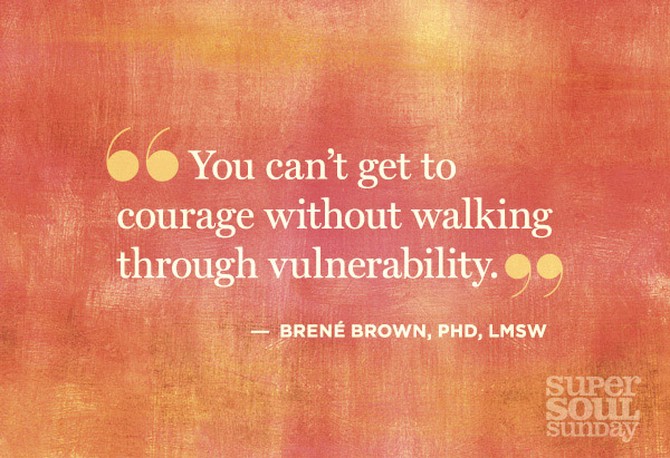
So when she got on stage and said that connection only happens when we risk vulnerability, it was like she was standing in my dojo pointing straight at me. The whole posture I had developed — invulnerable, distant, unshakable — didn’t feel like strength anymore. To me, it felt more like a wall. And what my students needed wasn’t a wall. They needed a human being who could connect with them.
That realization was groundbreaking for me. It didn’t just change how I taught; it changed how I lived.
In some ways, it made me too open, too trusting. But more than anything, it took away the crushing pressure I had put on myself to always be “on.” I realized vulnerability wasn’t weakness, and it also wasn’t performance. Performative vulnerability, the kind people trot out for sympathy points, is just manipulation. What I’m talking about is honesty. The kind where you tell the truth, even when it’s awkward, and even when it doesn’t make you look good.
What that looked like in practice was me becoming a different kind of teacher. Kinder. More open. Not everyone knew what to make of it, because anytime you shift tradition, there’s resistance. But for me, it was worth the risk. Inside those walls, I felt like I was finally building something real.
We produced strong martial artists. We won at tournaments. One year, we even took home the big trophy. But more importantly, we built belonging. And I will never, ever regret that.
Over time, I kept listening. I devoured her books on tape and hunted down every interview, lecture, and clip I could find online. I’ve got a whole mental filing cabinet of her quotes at this point, little teaching tools I use every day. One that has stayed with me is this: I belong anywhere I am being genuine to myself.
I don’t know if that’s word-for-word, but I know it’s the heart of what she meant. And for someone who has wrestled with self-worth my entire life, that line was like CPR. It shocked awake the memories of when I hadn’t been genuine, all the times I’d tried to be more than I was, and forced new air into them. It reminded me that belonging doesn’t come from being flawless, or from pretending to be untouchable. Belonging comes from showing up as real, and trusting that the right people will meet you there.
More recently, on one of her TV specials, she told a story about a totem she keeps. It’s a ring she wears on her finger, and she uses it like a fidget spinner whenever she’s uncomfortable. When she turns it on her finger, she repeats to herself: Choose discomfort over resentment. Choose discomfort over resentment.
That phrase has become a part of me.
I practice it now. When conflict rises up, I ask myself: am I going to choose silence, the path of least resistance that feels easier in the moment? Silence may not rock the boat, but it also doesn’t fix anything. And silence born out of fear will eventually turn into resentment. But there is a difference between healthy distance and silence. Sometimes stepping back is the right call. In a healthy relationship, staying quiet in conflict that matters is corrosive. In an unhealthy relationship, staying quiet in conflict can be self-preservation. And it’s important to recognize the difference.
So the real choice is this: sit on your feelings until they sour, or face the short burn of discomfort that clears the air. The burn hurts, but it passes, like when you dump too much wasabi into your soy sauce. At first it suffocates you, and then suddenly you’re free.
I learned that distinction the hard way. There are people who see your pain and instead of helping, they decide to take inventory of it and then measure it against their own. You know those people, right? Your financial challenges are not as bad as theirs, your stress isn’t as bad as theirs, your pain isn’t as bad as theirs, and you can’t possibly understand what THEY are going through.
In martial arts we call that walking around with a full cup, with no room for anyone else and nothing else except your own needs.
But then there are the other kind of people, the ones who prove the rule by fighting to stay. About a decade ago, before I’d even heard of Brené Brown, one of my closest friends sat me down because I was unraveling. Old insecurities and rivalries were getting the better of me, and I was slipping into patterns that weren’t good for me or for anyone around me. She looked me straight in the eye and said, I love you, but I can’t take much more of how you’re acting. You need to deal with this because I don’t want to lose you. It was blunt, it was uncomfortable, and it changed my life. Here was someone who wanted me in her life badly enough to risk honesty. She didn’t drift away or leave me guessing. She told me the truth. That day she taught me that silence kills, but discomfort can heal. And she’s still my favorite person in the world because she gave me that gift.
And then, a decade later, I heard Brené Brown say the same thing on a TV special. And the whole thing came full circle.
That’s the litmus test. Vulnerability shows you who’s in your corner. Some people avoid discomfort, erase your honesty, pretend your words don’t exist. Others sit in the fire with you, even when it burns, because the relationship is worth it.
And me? I’ve stopped pretending that armor makes me strong. Armor just keeps people away. What makes me strong now is choosing discomfort over resentment, again and again. Not because it’s easy, but because it’s worth it. And because the people who stay through the discomfort are the ones I want in my corner forever.
So what about you? Who or what cracked something open in you and left you changed for good? What book, what quote, what person rearranged the furniture in your head and left you better than before?

 It's Fine, I'm Fine, Everything's Fine