Her Own Compass shares financial education and personal experience, not individualized financial, investment, or tax advice. Every situation is different, so please consult a qualified professional before making major money decisions.
Money saving jar ideas work because they separate travel cash from every other dollar you touch, keeping a fund growing instead of disappearing into groceries and gas. A single mother on r/AskWomenOver30 puts money away whenever she can, sometimes $10 and sometimes $50, whatever is left once rent and bills clear. The trip she pictures has been out of reach for a while, so weekend getaways fill in instead. These 7 jar systems turn that same leftover cash into a fund you can watch grow.
The short version: The best money saving jar ideas keep travel cash physically separate from spending money: envelope splits, a $5-only jar, round-ups, and small daily challenges. Because the cash is visible and hard to accidentally spend, most jar systems add $250 to $1,400 a year without touching your regular income.


Save this for later
You will want this again. Pin it to your planning board so it is one tap away when you need it.
Pin it for laterWhy does jar-style saving work better than an app for a travel fund?
Jar-style saving works because it makes travel cash physically separate and visible, which removes the mental math an app hides behind a single balance. A reader on a Dave Ramsey thread listed a future pet fund 7 years out, new carpet 3 years away, and a washer and dryer 5 years out, then asked how not to feel overwhelmed by having so many things to save for at once, calling it exhausting even on a decent income. Travel savings competes against that same queue inside one banking app, and it usually loses because no deadline forces it.
A jar sidesteps that queue entirely. Behavioral economists call this mental accounting: money treated as belonging to a specific goal gets spent on that goal far less often than money sitting in one general pool. The CFPB’s Start Small, Save Up program is built on the same idea, small, separated, visible savings goals outperform one big vague target. A jar on the counter does the same job as that federal program, just without an app.
But does it matter which jar system you use, or is any jar good enough? The mechanism matters more than the container. What makes each idea below work is a rule that removes the daily decision, so saving happens automatically instead of depending on willpower every single day. This site’s full collection of travel fund saving challenges covers more ways to build on these habits once one of them sticks.
The Envelope Split Jar
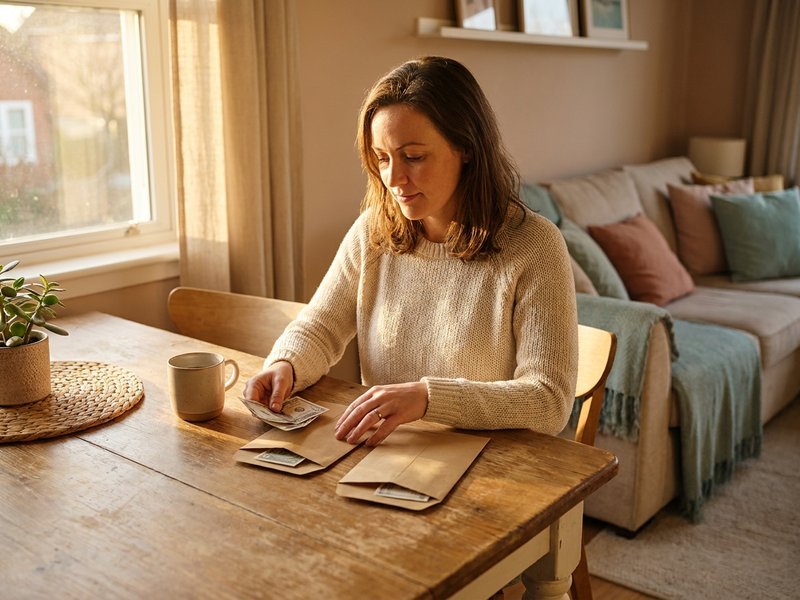
The Envelope Split Jar means dividing any spare cash into two labeled containers the moment it arrives, so it is already assigned before you can rethink it. One woman married for 36 years still runs this exact system. For the first 5 years of her marriage she did not work, and her husband handed her a monthly allowance in an envelope. Whatever was left over by month’s end, sometimes only 100 or 200 rupees, she kept as her own savings.
Once she started teaching and earning her own small salary, she split it the same way: his envelope on one side of her cupboard, hers on the other, and neither one touched what the other saved. Even 36 years later, he still hands her that monthly envelope, and what accumulates from both sides has become the cash they use for sudden trips or whenever something comes up that needs money right away.
How much goes in each envelope
Start with two labels: Bills and Travel. Any cash that is not already spoken for, a refund, a $20 you forgot about, loose bills from your wallet, goes into the Travel envelope first, not last. If money is tight some weeks, the Bills envelope gets priority, but the split itself never disappears, even a $2 week keeps the habit alive.
What happens when your envelope runs empty
An empty Travel envelope is not a failure, it is information. It means the last few weeks had nothing spare, not that the system is broken. Leave the empty envelope in place and keep adding the moment cash shows up again. The 36-year version of this system survived because the rule stayed simple enough to restart without guilt.
This site’s full guide to setting up sinking fund categories covers how to split cash once you have more than one goal competing for the same jar.
The $5-Only Jar
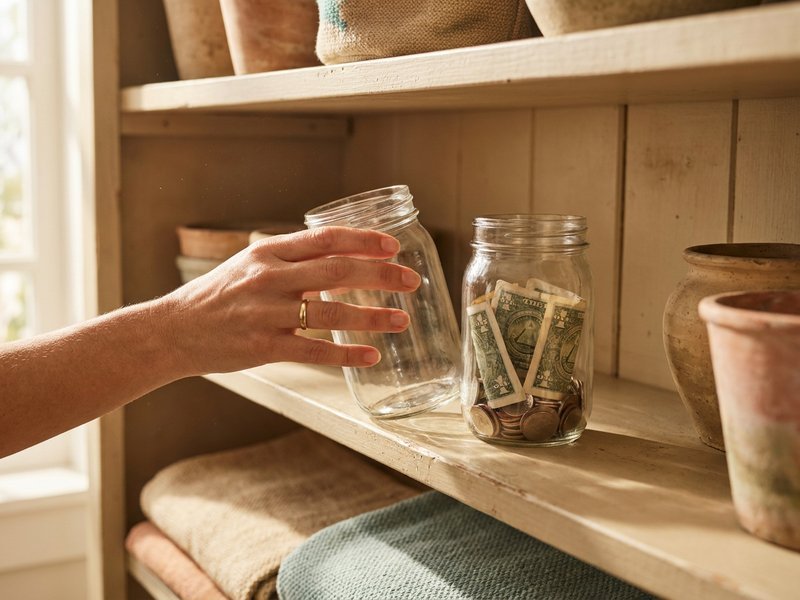
The $5-Only Jar means every $5 bill that lands in your hand goes straight into the jar instead of your wallet, no exceptions. Cashiers hand out $5 bills constantly in change, and because you rarely spend one on purpose, this rule barely changes daily life. A household that gets even one $5 bill a week adds roughly $260 a year without a single extra trip to the ATM.
But what if you rarely carry cash and almost never get a $5 bill in change? Widen the rule to any $5 or $10 bill, the mechanism stays the same, only the pace changes. The rule works precisely because it is rigid. A $10-and-under rule feels flexible enough to break; a $5-only rule does not, because you almost never need to break a $5 for anything smaller. Keep the jar somewhere you actually see it, a kitchen counter beats a closet shelf, since the visible total is half of what keeps the habit going.
The Loose Change Jar
The Loose Change Jar catches every coin from every purchase, and a typical one-person household fills a quart-sized jar with $50 to $100 over 3 to 4 months. This is the slowest jar on this list, but also the one that costs nothing to start and asks for zero decisions once it is in place.
Is it worth paying a coin-counting fee just to cash it out faster? Usually not. Most banks and grocery store coin machines will convert a full jar into paper bills or a gift card for a flat fee or a percentage cut. Skip the fee entirely by rolling coins yourself or depositing them through your bank’s coin counter if it has one. Either way, the coins mean nothing on their own; the jar is what turns them into a number worth watching. Women running a full cash stuffing system often fold a loose change jar in as the catch-all category for whatever doesn’t fit a labeled envelope.

The Round-Up Jar
The Round-Up Jar means rounding every purchase up to the next $5 and moving the difference into savings, whether you do that by hand or through a banking app. A $23 grocery run rounds to $25, so $2 moves to travel. A $67 gas fill-up rounds to $70, so $3 moves. Neither amount is noticeable alone; together across a month, they add up fast.
Rounding up by hand vs. rounding up in an app
By hand means keeping a small notebook or your phone’s notes app, writing the round-up amount after each purchase, then moving that total into the jar or a savings account once a week. An app version, many banks now offer round-up savings as a free feature, automates the same math on every card swipe. The app version is more consistent; the by-hand version is free everywhere and works even at a bank that doesn’t offer round-ups.
How fast a round-up jar adds up
A woman making 20 to 30 purchases a month, averaging a $2 to $3 round-up each, saves $40 to $90 a month without changing a single spending habit. Over a year, that is $480 to $1,080, enough to cover flights for a modest domestic trip using nothing but spare change from purchases already being made.
The Extra Income Jar
The Extra Income Jar means any money that was not part of your regular paycheck, overtime, a freelance gig, a refund, a birthday check, goes straight to travel instead of blending into checking. Because this money was never budgeted for bills in the first place, moving it to the jar costs nothing you were already counting on.
What if your income changes month to month and there is no predictable “extra” to work with? The rule still applies, it just applies less often. A month with zero extra income means zero extra in the jar, and that is fine; the system is built to flex with irregular income instead of demanding the same fixed deposit every month.
The 52-Week Challenge Jar
The 52-Week Challenge Jar means saving $1 in week 1, $2 in week 2, and so on up through $52 in week 52, ending the year with $1,378 total. The classic version starts small and ramps up, which makes the first few months feel almost too easy, then gets noticeably harder by fall.
What happens if you miss a week entirely? Add that week’s amount onto the next one, or skip it and keep going, either way the streak matters more than a single missed deposit. Run it in reverse if the ramp-up timing works against you: $52 in week 1 down to $1 in week 52 front-loads the hardest weeks while motivation is highest, and coasts to the finish. Either direction lands at the same $1,378, roughly a full flight and several nights of lodging for a one-income traveler.
The No-Spend Day Jar
The No-Spend Day Jar pays you $5 to $10 every day you spend nothing beyond fixed bills, turning restraint into a number you can watch grow instead of an invisible virtue. A woman who manages 15 no-spend days a month at $7 a day adds $105 monthly, or roughly $1,260 a year, just from days that already cost her nothing.
The federal financial literacy site MyMoney.gov lists no-spend challenges among the small habits that build saving muscle without requiring a higher income. Track no-spend days on a wall calendar next to the jar; seeing the streak matters as much as the dollars themselves.
How do you protect your travel jar from other expenses?
You protect a travel jar by keeping it in a separate container or account from anything that covers repairs, pets, or emergencies, because a shared pool gets drained by whichever expense shows up first. One budgeter on r/TheMoneyGuy consolidated several goals into a single fund after quitting a job, then watched it get wiped out. Contributions built up from January to June, then a string of home repairs hit at once, followed the next week by veterinary wellness exams for three pets. Six months of saving left nothing for anything discretionary.
A travel jar sharing space, physical or digital, with home and pet costs is exposed to exactly that sequence. The FDIC’s Money Smart curriculum teaches this as a core rule: separate accounts for separate goals, specifically because pooled money gets claimed by whichever need feels most urgent that week, and travel rarely feels urgent next to a leaking roof.
Is it too late to separate your jars if you have already been mixing them for months? No. Split the current balance by rough percentage, count what you have earmarked mentally for travel versus everything else, move it into two containers today, and keep them separate from that point forward. Once any single jar grows past a few hundred dollars, moving it into a dedicated high-yield savings account built for your travel fund keeps it both separate and growing faster than cash sitting in a jar.
The bottom line on money saving jar ideas
A couple who inherited $2.7 million still builds every trip around a $150-a-night lodging cap, usually closer to $110, and $40 to $50 a person for the one nice dinner they allow themselves on the road. They take two trips a year now instead of the one they used to manage, and every so often they remind each other out loud that they can afford a little extra. Keeping the old rules is its own quiet kind of win, whether your jar holds $12 or your account holds seven figures. Pick one idea from this list and start it today. You’re funding this, one $5 bill at a time.
Found this helpful? Pin this guide so you can come back to it anytime.
Frequently Asked Questions
What is a money saving jar?
A money saving jar is a physical container used to hold cash for a specific goal, like a travel fund, separate from everyday spending money. The separation is what makes it work: cash you can see and touch gets spent far less often than money sitting inside a general bank balance.
How much should I put in my travel jar each week?
There is no fixed amount, the round-up and $5-only jars above add $40 to $90 a month from spare change alone, with zero new income required. Start with whichever jar matches cash you already touch, then increase the amount only once the habit feels automatic.
Is it too late to start saving for a trip with jars instead of an app?
It is not too late, and jars often outperform apps early on because the cash is visible instead of buried in a balance. Most of these systems take under a minute to set up and start working the same day, so the only real cost of waiting is one more week without a jar.
What are good money saving jar ideas for beginners on one income?
The $5-Only Jar and the Loose Change Jar are the easiest starting points on one income, since both use money you already touch and ask for zero new budgeting. Add the Round-Up Jar once the first habit sticks, since it grows the fund faster without requiring extra cash.