This post contains no affiliate links today. If that ever changes, I will say so right here, at the top of the post. This reflects real travel experience and research, not a promise that any one trip costs the same for every traveler.
Solo travel europe over 50 usually gets planned in theory for years before anyone actually books a flight, and the theory almost never involves a specific itinerary. One woman described the moment basic financial literacy finally clicked for her, according to an account she shared on TikTok: nobody in her house ever talked about investing, and the whole subject felt built to keep women like her out, until she realized the information itself was free and public all along, and the hard part was never her intelligence, it was that no one had handed her the door. Solo travel europe over 50 works on the same hidden door. The routes below are not more expensive or more complicated than a group tour; they are just rarely handed to a woman as an option before she goes looking for it herself.
The short version: The best solo travel europe over 50 trips fall into three shapes: a slow coastal stretch reached by train, a countryside route built around wine or châteaux, and one deep, month-long stay in a single region. All nine below are reachable without a rental car, forgiving on a first solo attempt, and priced for a real budget, not a fantasy one.

Save this for later
You will want this again. Pin it to your planning board so it is one tap away when you need it.
Pin it for later1. The Algarve Coast, Off-Peak (Portugal)
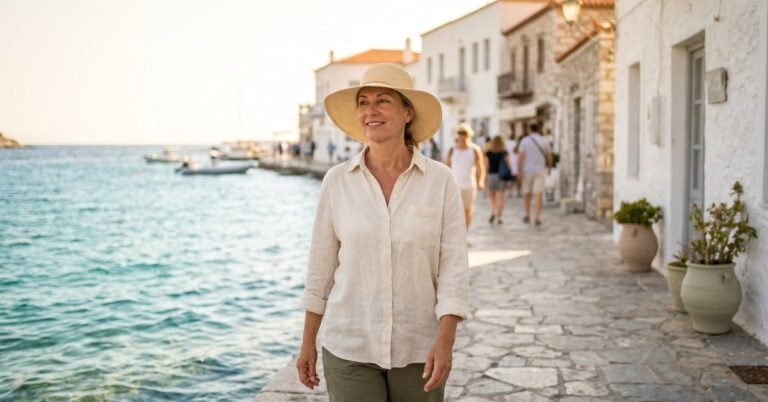
The Algarve’s coastal towns run noticeably cheaper and quieter from October through April, with direct trains connecting Lagos, Faro, and Tavira along a single coastal line. A private room in a guesthouse averages roughly $45–65 a night in that window, compared with $110+ in July. No car is needed for the main towns; the regional train covers the whole stretch in under two hours end to end. It is, for good reason, the trip most solo travel europe over 50 guides open with.
2. The Douro Valley by Train (Portugal)
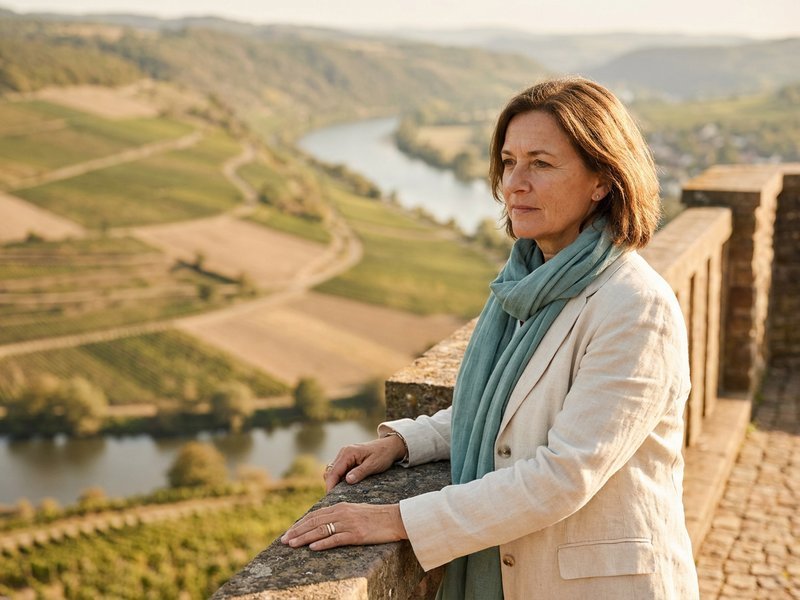
The Linha do Douro train line runs directly from Porto through the terraced vineyard valley to Pocinho, a single scenic track with no transfers and no driving required. A round-trip day pass runs under $30, and river-view seats on the right side of the train (heading east) face the vineyard terraces the whole way. Solo travel europe over 50 rarely gets easier than a train window and a packed lunch.
3. Sicily’s Slow Circuit (Italy)
Sicily draws a fraction of mainland Italy’s solo-female-travel search volume despite comparable trains and lower hotel prices, roughly 20–30% cheaper on average for a mid-range room. Worth trading the more famous coastline for a quieter one? The lower prices alone make the case. A circuit through Palermo, Cefalù, and Taormina runs entirely on regional rail, with Cefalù in particular built for a slow few days: flat old-town streets, a walkable beach, and no need to change towns more than twice in a week.
4. The Dalmatian Coast by Ferry (Croatia)
Jadrolinija’s public ferry network links Split, Hvar, and Korčula on a fixed timetable, so island-hopping down the Dalmatian coast never requires a car or a private boat transfer. Need to rent a car to island-hop here? Not when a ferry already does the driving. A one-way ferry ticket runs $8–20 depending on distance, and each island is small enough to cover on foot in a day. It reads as a far more remote trip than it actually is to plan.
5. A Loire Valley Château Loop (France)
The Loire Valley is flat enough that several of its best-known châteaux, Chenonceau, Amboise, and Chaumont among them, sit within a comfortable bike ride or short local train of one another out of the town of Tours. A regional day pass covering the whole loop runs under $20. Renting a bike for a single afternoon between two châteaux is one of the few genuinely low-effort ways to cover real ground solo.
You Don’t Need a Perfect Plan to Start
A woman who quit a well-paying, miserable career at 41 described the year that followed on r/AskWomenOver40: she and her husband bought a cheap RV and spent months traveling the national parks before she let herself think about what came next. When she eventually went back to school, a master’s degree turned out to be far easier than expected with sixteen years of work experience behind her. She earns less now than she did in that old job, and it took a long time before she stopped second-guessing the trade. The same permission applies here: none of these nine trips need a five-year plan first, only a next open week.
6. Iceland’s Ring Road, Off-Season
Iceland’s Ring Road can be covered without a rental car via Strætó, the public bus network, which runs the full loop on a fixed schedule for a fraction of a rental’s daily cost. Shoulder-season lodging (April–May, September–October) runs 30–40% below peak summer rates. A woman traveling alone can still hit the major stops, waterfalls, black-sand beaches, geothermal pools, on public transit alone.
7. The Camino Portugués, Coastal Route (Spain/Portugal)
The Coastal Camino Portugués covers roughly 175 miles from Porto to Santiago de Compostela over 10–12 days, noticeably flatter than the French Way and walkable at a slower daily pace of 8–12 miles. A pilgrim hostel bed runs $12–20 a night. The route is dense with fellow solo walkers of every age, which makes it one of the least isolating ways to travel completely alone.
How Long Can You Stay in Europe Without a Visa?
Americans can stay up to 90 days within any rolling 180-day period across the entire Schengen Area, which covers most of the countries on this list, not per country visited. Is that enough for a multi-country loop? For any single trip on this list, yes. Where it gets missed is stacking two of these trips back to back inside the same six months: Portugal, Croatia, and Iceland are all Schengen members, so days spent in one count against the 90-day limit for all the others. The European Commission’s official Schengen Area page has the current country list and day-counting rules before booking a second trip inside one calendar year.
Do You Need $10,000 Saved Before You Book a Solo Trip to Europe?
No: budgeting guides for a first extended solo trip commonly open with a savings target of $10,000 to $15,000, but that number assumes paying full price for every night of the trip, which is not the only way to do it. One Reddit commenter undercut that floor entirely after a failed business left her with almost nothing saved, writing in r/solotravel, verbatim: “I use Workaway app- this allows me to find accommodation in exchange for helping out.” Roughly 30 to 90 minutes of daily work at a hostel covered her room and weekly grocery cash. Below a certain spending pace, room and food get earned in real time instead of drawn from a savings account. Is a $10,000 cushion still nice to have? Certainly, but it is not the price of entry it is usually presented as.
8. Scotland’s Outer Hebrides (UK)
CalMac’s ferry network connects the Outer Hebrides islands, Lewis, Harris, and North Uist among them, on a public timetable that a solo traveler can build an entire week around without renting a car. Isolating, traveling this far north alone? Summer daylight running past 10 p.m. makes it feel like anything but. Small-group minibus day tours, typically $35–55, cover the parts of each island that are hard to reach on foot. The U.S. State Department’s international travel advisories are worth a quick check before any of these nine, solo or not.
9. A Slow Month in Provence (France)
Avignon’s TGV station puts a dozen Provençal market towns within a 30–45 minute regional train ride, which makes a full month based in one town, rather than moving hotels every few days, both cheaper and considerably less tiring. A month-long apartment rental typically runs $900–1,400 total, well under the per-night cost of a month of hotel stays. The town starts to feel lived-in, not visited, by the third week.

One woman who introduced her husband to the FIRE movement described the moment the math finally pencilled out, according to an account she shared on r/Fire: between two properties and a primary home, all still carrying mortgages, she and her husband ran their actual expenses against their budget and could not believe how attainable the plan turned out to be, with a kid on the way and a mortgage they will not have to worry about for much longer. It gave both of them a real lift.
Solo travel europe over 50 tends to arrive at readiness the same quiet way: not a dramatic windfall, just an honest look at the number, followed by the realization that it was closer than it felt. Pick one of the nine above. Book the flight before the theory gets a tenth year added to it.
Anyone ready to travel with company some of the time can compare the best women-only tours for solo travelers over 50, or start with the solo travel over 50 hub for the full list of guides on this site.
Found this helpful? Pin this guide so you can come back to it anytime.
Frequently Asked Questions
What is the most affordable solo trip to Europe for a woman over 50?
The Camino Portugués coastal route and off-peak Algarve both run cheapest: pilgrim hostel beds cost $12–20 a night, and Algarve guesthouses run $45–65 in the October–April off-season, both without a rental car.
Do you need $10,000 saved before a solo trip to Europe?
No. That figure assumes paying full price every night. Work-exchange platforms like Workaway can cover room and food in exchange for a few hours of daily help, which changes the real savings floor considerably.
How long can Americans stay in Europe without a visa?
Up to 90 days within any rolling 180-day period across the whole Schengen Area, which counts total days across all Schengen countries combined, not per country. Two long trips within the same six months can bump against that limit.
Can you do these trips without renting a car?
Yes, all nine are built around trains, public ferries, or regional buses: Portugal’s rail lines, Croatia’s Jadrolinija ferries, Iceland’s Strætó bus network, and Scotland’s CalMac ferries all cover the routes described here.
Which trip is best for a first solo trip to Europe over 50?
The Algarve coast or the Loire Valley château loop are the gentlest starting points: short travel times between stops, widely spoken English, and no long walking days required.