This post contains no affiliate links. If that ever changes, I will say so right here, at the top of the post. Every story below comes from a woman who actually booked the trip, not a stock-photo daydream.
Solo travel over 50 for beginners starts with one trip, not a five-year plan. You do not need a travel companion lined up, a second income, or anyone’s blessing to book a flight and go by yourself. One woman had traveled alone before, but only for work. Her first real solo trip was different: seven days with nothing to fill but herself, arriving after six years of needing a cane, and at times a wheelchair, through the airport. By day four she knew she could still get herself from A to B, and that alone felt like an achievement.
The short version: Solo travel for women over 50 works best when you start with a structured trip style (a small-group tour or a cruise solo cabin), pack one bag under 25 lbs, and budget $150 to $300 a day depending on destination. The safety data is better than the warnings suggest.


Save this for later
You will want this again. Pin it to your planning board so it is one tap away when you need it.
Pin it for laterWhat Solo Travel Over 50 for Beginners Actually Looks Like
Solo travel over 50 for beginners means picking one trip, choosing a structure that gives you a little built-in company, and going before you feel fully ready. It is not backpacking through six countries with a 40-liter pack. Most first-timers over 50 choose a small-group tour, a solo cruise cabin, or a single-destination trip with a hotel base, then build independence from there.
A widely shared claim says women solo travel far more than men, but that number rests on shakier ground than it looks. One detailed breakdown on r/solotravel pointed out that the often-cited 75% figure likely comes from group-tour company bookings, not solo travel overall, and that older, retired travelers and empty-nesters skew the female share because women live longer and regain free time once children leave home. The same commenter argued the opposite is closer to true worldwide, since men simply post about solo trips less often. What does that mean for you? The “gender gap” in solo travel marketing is a marketing artifact, not proof that women over 50 are unusual for wanting to go alone.
Why Women Start Solo Travel After 50
Most women start solo travel over 50 after a life change frees up time, money, or both. Kids move out, a marriage ends, retirement starts, or a health scare resets what matters. The trigger is rarely “I finally feel brave enough.” It is closer to “I finally have the room.”
One woman described her first real solo trip this way: she had traveled alone before, but always for work. This time was different. Seven days with nothing to fill but herself, arriving after more than six years of needing a walking stick, a cane, and at times a wheelchair through the airport. By day four she already knew a few things for certain. She was still capable of getting herself from A to B without falling apart, and that alone felt like an achievement. She was happy in her own company, though she would still rather have someone to share the view with. She packed one small suitcase, two and a half kilograms under the weight limit, which felt unheard of for her. She walked more than she expected to and slept better than she had in years.
Notice what is missing from that story: no perfect confidence, no total fearlessness. Just one trip, taken anyway.
Is Solo Travel Safe for Women Over 50?
Yes, solo travel is statistically safer for women over 50 than the warnings around it suggest, as long as you take the same precautions you would at home. Solo travel advice aimed at women almost always assumes strangers are the danger, but crime data undercuts that framing. In a recent year with 17,713 recorded U.S. murders, 78% of victims were male and 22% were female. Stranger-perpetrated killings followed the same pattern: 21% of male victims and 12% of female victims were killed by someone they did not know. Most women who are murdered are killed by someone they know and trust, commonly a partner, not by a stranger encountered while traveling alone.
That does not mean skip the basics. Share your itinerary with one person at home. Check your destination against the U.S. Department of State’s travel advisory levels before booking, and register your trip with the State Department’s free STEP program if you are heading abroad. Check CDC travel health guidance for your destination a few weeks out, since vaccine and water-safety recommendations vary a lot by country. None of this is about fear. It is the same due diligence you would do before letting a friend borrow your car.
How Do I Choose My First Solo Trip Style?
Choose a trip style that gives you built-in structure for your first solo trip, then loosen the structure on your second and third trips. The three most common starting points are a small-group tour, a cruise with a dedicated solo cabin, and a single-destination independent trip. Each solves a different worry.
Small-Group Guided Tours
A guided tour hands you a built-in group without the pressure of planning every stop yourself. One woman signed up for a small-group sailing tour alone at 52, guessing that a company known for budget backpacker trips would fill the boat with people half her age. It did not happen that way. She turned out to be the youngest person on board, and by a comfortable margin. The whole trip changed how she picks solo tours now. She stopped assuming “budget tour company” automatically means “young crowd.”
So how do you know before booking? Ask the operator directly for the average age on your specific departure date, not a general company average. Departures shift by season and by region.
Cruises With Solo Cabins
Several major cruise lines now sell studio cabins built for one traveler, which sidesteps the old single-supplement fee that used to double the cost of a cruise for a solo passenger. One woman ended up cruising solo when her husband could not get the time off. They had always sailed together and always paid for a balcony, but going alone changed the math completely. She booked one of the line’s solo studio cabins instead, small with no window on older ships, but it came with its own lounge and a coffee machine she liked more than she expected. She skipped the balcony upgrade bid, since it can run $400 more, and stuck with the studio. On her sailing, the studio priced out $500 cheaper than an inside cabin, though that gap changes sailing to sailing.
Independent, Single-Destination Trips
The lowest-structure option is booking one hotel in one city and figuring out days as you go. This works best once you have one guided trip or cruise behind you, since it removes the built-in social layer those options provide. If you want to try it first, pick a walkable city with a strong public-transit system so you are not renting a car alone in an unfamiliar place on day one.
What to Pack for a First Solo Trip Over 50
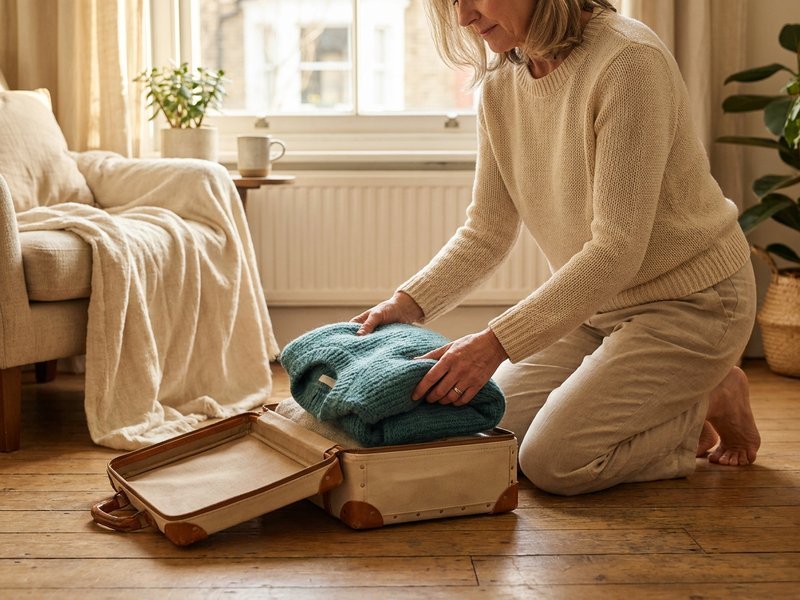
Pack one bag you can lift and carry yourself for more than 10 minutes, and weigh it before you leave the house. Solo means no one else is carrying your suitcase up a train platform stairwell. One woman who has flown solo repeatedly keeps her suitcase two and a half kilograms under the airline weight limit every time, on purpose, because a bag she cannot lift alone is a bag that turns into a problem the second an elevator is broken.
- One carry-on suitcase or a soft-sided bag under 25 lbs (about 11 kg)
- A cross-body bag you can wear front-facing in crowds
- A printed copy of your itinerary and one emergency contact card, in case your phone dies
- A portable charger, since solo travelers rely on their phone for maps, translation, and check-ins home
For a full packing breakdown by season and destination, our carry-on packing guide for minimalist travelers goes deeper on exact items.
What Can Go Wrong on a First Solo Trip (And How to Plan Around It)
The most common thing that goes wrong on a first solo trip over 50 is picking a destination that is harder than your fitness or heat tolerance allows, not a safety incident. One woman booked a solo group trip to Rajasthan, India, at almost 66, drawn in by the operator’s senior-friendly marketing and reasonable price. The company itself did a good job on logistics, and her guide had 14 to 15 years of experience and was excellent. But India at over 100 degrees every day, with crowds and heavy pollution everywhere she turned, was more than she could handle. She came down with a bad stomach illness and spent her last days stuck in hotel rooms near a bathroom instead of seeing the country. She said afterward she wished she had picked a gentler destination for a first solo trip.
Does that mean skip the ambitious destination entirely? No. It means match your first destination’s climate and pace to your actual body, not to the destination’s marketing photos, and save the physically demanding trip for your third or fourth solo trip, once you know your own limits on the road.
Eating and Socializing Alone Gets Easier Fast
Eating alone gets easier after the first meal, and most solo travelers over 50 say the discomfort fades within about 10 minutes of sitting down. One woman described booking her first solo trip to Florence at 55, scared and excited in equal measure. The part that made her stomach flip was not the flight or the hotel. It was walking into a nice restaurant and asking for a table for one at dinner. She was perfectly confident sitting at a bar back home, but reserving a table for herself felt like a different kind of brave. She decided to do it anyway.
What actually helps? Book the early seating, before a restaurant fills up and a table for one feels more noticeable. Bring a paperback or a journal, not as a prop, but because it gives your hands something to do between courses. And remember that restaurant staff genuinely do not think twice about a solo diner your age. They see it every week.
Small-Group Tour vs. Cruise vs. Independent Trip
Here is how the three most common first-trip styles stack up on cost, built-in company, and how much you have to plan yourself.
| Trip Style | Best For | Typical Cost Range | My Take |
|---|---|---|---|
| Small-group guided tour | First-timers who want a built-in group without planning stops | $150-$300/day, tour-dependent | Ask for the average age on YOUR departure date, not the brochure average. |
| Cruise, solo studio cabin | Travelers who want structure plus their own space at night | Often $400-$500 less than an inside cabin, no single supplement | The solo lounge is where you actually meet people. Skip the balcony upgrade bid your first time. |
| Independent single-destination trip | Second or third solo trips, once you know your pace | $100-$250/day depending on city | Pick a walkable, transit-friendly city first. Save the harder logistics for later. |

Budgeting for Your First Solo Trip on One Income
Most first solo trips over 50 cost between $1,500 and $3,500 for a week, depending on trip style and destination, and a dedicated travel fund gets you there without touching your regular budget. Set a target based on your chosen trip style’s daily range, multiply by trip length, then divide by the months you have until departure. But what if your income changes month to month? Base the monthly savings target on your three lowest-earning months, not your average month, so a slow month never wrecks the plan.
Solo trips also carry one hidden cost worth planning for: reentry. The week after landing, you are unpacking, catching up on laundry, and often back at work within days. Budgeting a small reentry cushion, even $100 to $200, means you are not white-knuckling your first week home the way you were your first week away.

When Should You Book Your First Solo Trip?
Book your first solo trip for 8 to 12 weeks out, long enough to save and plan, short enough that you cannot talk yourself out of it. Why that window specifically? Any longer and doubt has time to creep in. Shoulder-season months, meaning the weeks just before or after a destination’s peak season, tend to combine lower prices with smaller crowds, which matters more on a first solo trip than it will later. If slower travel appeals to you once you have one trip behind you, our guide to slow travel destinations built for taking it easy covers where that pace works best.
Ready-Made First Trips to Consider
If you want a next step instead of an open-ended search, two starting points come up again and again among first-time solo travelers over 50: our guide to women-only tours built specifically for solo travelers over 50, and our breakdown of travel insurance for solo female travelers over 50, since a first trip is the wrong place to skip coverage. For every other guide in this series, our solo travel over 50 hub collects them in one place.
A few years ago, at 48, one woman took up studying for a demanding professional certification, one of the hardest exams in her field. She developed a real passion for it and cleared the first stage on her first attempt. Her own words afterward stuck with me: age is no bar to reinventing yourself. That is true of a career change, and it is just as true of the first time you book a plane ticket with only your own name on the reservation. You are funding this trip, and you are the only one who has to say yes.
Found this helpful? Pin this guide so you can come back to it anytime.
Frequently Asked Questions
What is the best way to start solo travel over 50?
Start with a small-group tour or a cruise solo cabin instead of a fully independent trip. Both give you built-in company and someone else handling logistics, which lowers the first-trip learning curve. Once you know your pace, independent trips get much easier to plan.
How much does a first solo trip over 50 cost?
Most first solo trips run $1,500 to $3,500 for a week, depending on trip style. A small-group tour lands near $150 to $300 a day, while an independent city trip can run $100 to $250 a day. Build a dedicated travel fund based on your chosen style’s daily range.
Is it too late to start solo travel at 55 or 60?
No. Most solo travel over 50 marketing skews toward retirees and empty-nesters specifically because that is when the free time and confidence line up for a lot of women. First trips at 55, 60, and beyond are common, not exceptions.
Is solo travel over 50 safe for women?
Yes. Crime data shows most violence against women comes from someone they know, not a stranger encountered while traveling. Standard precautions, like sharing your itinerary and checking State Department travel advisories, cover the real risk without requiring you to stay home.
What should I pack for solo travel over 50 as a beginner?
Pack one bag under 25 lbs that you can lift and carry yourself for at least 10 minutes, plus a cross-body bag, a printed itinerary, and a portable charger. A bag you cannot manage alone turns small problems, like a broken elevator, into real ones.